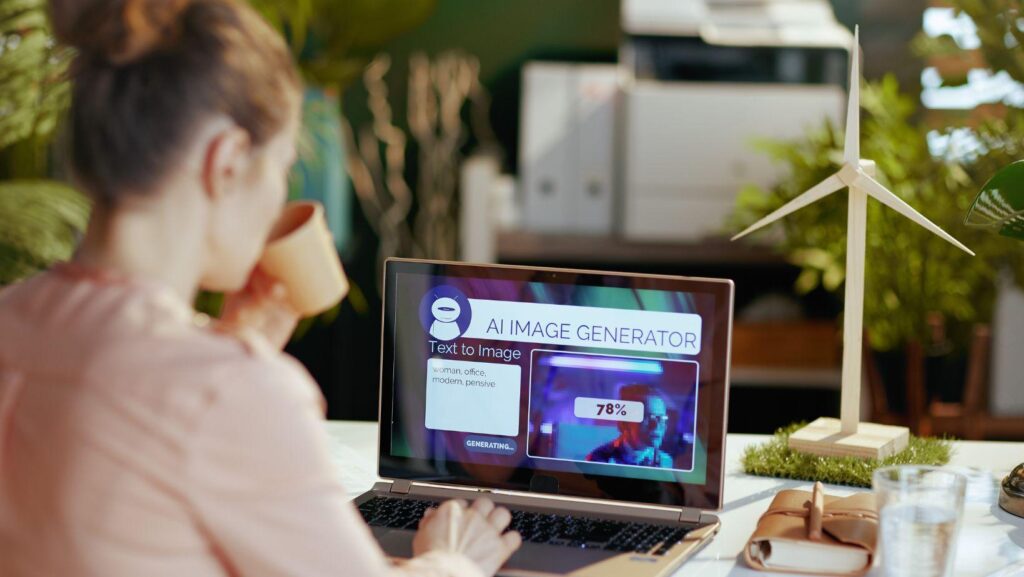
Artificial intelligence has moved beyond analyzing and organizing information. Today generative AI can create images from natural-language descriptions giving artists, marketers, designers, educators and content creators a faster way to explore visual ideas.
Modern AI image-generation systems can transform a prompt into illustrations, concept art, product visuals, portraits, backgrounds and other forms of digital imagery. The technology has developed rapidly with text-to-image models becoming increasingly capable of producing visuals while giving users more control over style, composition and editing. (DOI)
What Is an AI Art Generator?
An AI art generator is a software tool that uses artificial intelligence to produce images based on instructions supplied by a user. Those instructions can be as simple as descriptive words or as detailed as a complete creative brief.
For example a user might enter a describing:
- A futuristic city at sunset
- A watercolor landscape
- A minimalist product illustration
- A fantasy character in a particular environment
The system interprets the text and generates an image that attempts to match the requested subject, composition and aesthetic.
Many contemporary systems are based on models, including diffusion-based approaches. Research into text-to-image diffusion models focuses not on visual quality but also on issues such as robustness, fairness, privacy, security and explainability. (DOI)
How Does AI Image Generation Work?
Although the process appears simple from a user’s perspective, image generation involves complex stages.
First the system interprets the text prompt. Identifies important concepts, relationships and visual characteristics. The underlying model has learned relationships between language and visual patterns from its training data.
The model then generates an image according to those relationships. In diffusion-based systems generation generally involves transforming a representation into an increasingly structured image until a recognizable result emerges.
This allows the basic technology to support a wide range of visual styles. Depending on the model and prompt users can request scenes, digital paintings, sketches, illustrations or experimental artwork.
Why Are AI Art Tools Becoming Popular?
One major advantage is speed. Traditional visual production can require sketching, photography, illustration, editing or 3D work. Generative AI can provide a visual concept in a much shorter period.
That makes AI particularly useful during the stages of creative work. A designer can generate concepts before deciding which direction deserves further development.
AI image generation can also lower the barrier to visual experimentation. Someone without illustration skills can describe an idea in ordinary language and receive a visual interpretation of it.
Current industry discussions also emphasize AI as a creative tool rather than simply a replacement for human creators. Modern workflows combine generated material with human editing, art direction and judgment. (Adobe)
Common Uses for AI-Generated Images
1. Concept Development
Artists and designers can use generated images to explore ideas before committing time to a finished project. Multiple variations can help clarify composition, color, atmosphere and visual direction.
2. Marketing Content
Businesses can create concepts for campaigns, advertisements, blog posts, presentations and social media. AI-generated imagery can be particularly useful when a concept is difficult or expensive to photograph.
3. Social Media Graphics
Creators often need a supply of visual content. AI tools can help produce backgrounds, illustrations, thematic images and creative variations that can then be refined using design software.
4. Storytelling and Entertainment
Writers, filmmakers, game developers and other storytellers can use generated images for mood boards, character concepts, environments and visual development.
5. Education
Teachers and students can use image-generation technology to visualize settings, scientific concepts, fictional environments and other subjects that may be difficult to represent with conventional stock imagery.
How to Get Results From an AI Art Generator
The quality of the prompt can have a significant impact on the result. Only a broad phrase such as “a beautiful landscape ” provides useful visual context.
A detailed prompt might describe the:
- Subject: What should appear in the image?
- Setting: Where does the scene take place?
- Composition: What should be in the foreground or background?
- Lighting: Is it daylight, hour, studio lighting or nighttime?
- Style: Should it resemble a painting, photograph, illustration or another aesthetic?
- Mood: Should the image feel calm, dramatic, mysterious, playful or energetic?
Aspect ratio: Is the image intended for a website, presentation, poster or social platform?
For creators looking for a way to experiment with these workflows an AI art generator can be used to turn descriptive prompts into visual concepts and explore different creative directions.
The goal is not necessarily to write the possible prompt. Clear relevant details are usually more useful than adding keywords.
AI Generation Does Not Eliminate the Need for Human Editing
Generated images can be impressive. They are not automatically perfect. Users may encounter details, inconsistent objects, strange anatomy, unwanted visual elements or compositions that do not fit the original purpose.
Human review remains important for professional work.
A practical workflow is therefore:
- Define the objective.
- Write a prompt.
- Generate variations.
- Identify the concept.
- Refine the prompt. Edit the image.
- Check details carefully.
- Add human-designed elements where necessary.
- Review the image for its intended audience and use.
This approach treats AI as part of the process rather than the entire process.
Copyright, Authenticity and Responsible Use
The growing adoption of imagery has also created important questions about ownership, attribution, training data and responsible use. Researchers studying text-to-image systems have identified privacy, fairness, security, robustness and explainability as significant areas of concern. (DOI)
Creators should therefore consider the rules that apply to their project and the terms of the AI service they use. Commercial projects may require attention to licensing, brand requirements, identifiable people, copyrighted material and disclosure practices.
It is also important to avoid presenting AI-generated imagery as documentary photography when doing so could mislead viewers. The appropriate approach depends on the context and intended audience.
The Future of AI Image Generation
AI image generation is likely to become increasingly integrated into creative workflows. Existing as a standalone novelty image generation is becoming part of design, editing, marketing, storytelling and multimedia production.
Current research also shows that the field still involves technical trade-offs. Studies of text-to-image systems continue to investigate how models can balance image diversity, controllability, semantic accuracy and reliability. (Springer)
For creators this means the useful skill may not be simply knowing how to generate an image. Understanding how to communicate an idea, evaluate generated results, refine a concept and combine AI with human creativity can be equally important.
Conclusion
AI art generators are changing how people approach creation. By translating natural-language descriptions into images they make experimentation faster. Allow more people to explore ideas that once required specialized technical skills.
At the time effective AI-assisted creativity still depends on human direction. Strong prompts, selection, thoughtful editing and responsible use can turn generated imagery from a quick experiment into a useful part of a professional creative workflow.
As the technology continues to develop AI image generation is likely to remain a tool for people who want to explore prototypes and communicate visual ideas more efficiently.